A visual research exhibition titled ‘Occult Objects in India and England (1850-1940): Nuanced Perspectives’ was organised at the Nandan Gallery of Kala Bhavana in Visva-Bharati, Shantiniketan, from 25- 29 August 2025. The exhibition explored the diverse ways in which some occult objects and certain practices associated with them impacted the socio-cultural relationship between Britain and India during the latter half of the nineteenth and the beginning of the twentieth century. How such objects often fostered diverse forms of collaboration and networks between England and India, leading to the collapse of racial and colonial hierarchies, was brought to focus.
Around twenty eight panels were displayed showcasing the photographs of objects, newspaper cuttings, lists of index cards, cover pages of periodicals and books, etc. Occult objects stand for those items which were thought to have supernatural attributes, were associated with occult practices, were considered devious or cursed, and were imagined as capable of fulfilling secret wishes, dark desires which otherwise were considered taboo or were forbidden.
Advertisement
The exhibition portrayed how occult objects led to the movements of goods and people between England and India during the said time period. What sort of cultural assimilations, adaptations, and exchanges followed, got highlighted. The exhibition helped visitors understand how often, through those objects, oriental fantasies, stereotypes, and fetishes were asserted and reinforced.
The impact of the occult items upon the trade networks, performance culture, healing practices, etc., was addressed during the exhibition. Their connection with the new religion and alternative spiritualities was focused upon. How occult objects became part of popular culture and had a mass appeal was projected through some of the panels. How the print culture played a prominent role in disseminating ideas about, promoting, and in marketing of occult goods was also explored.
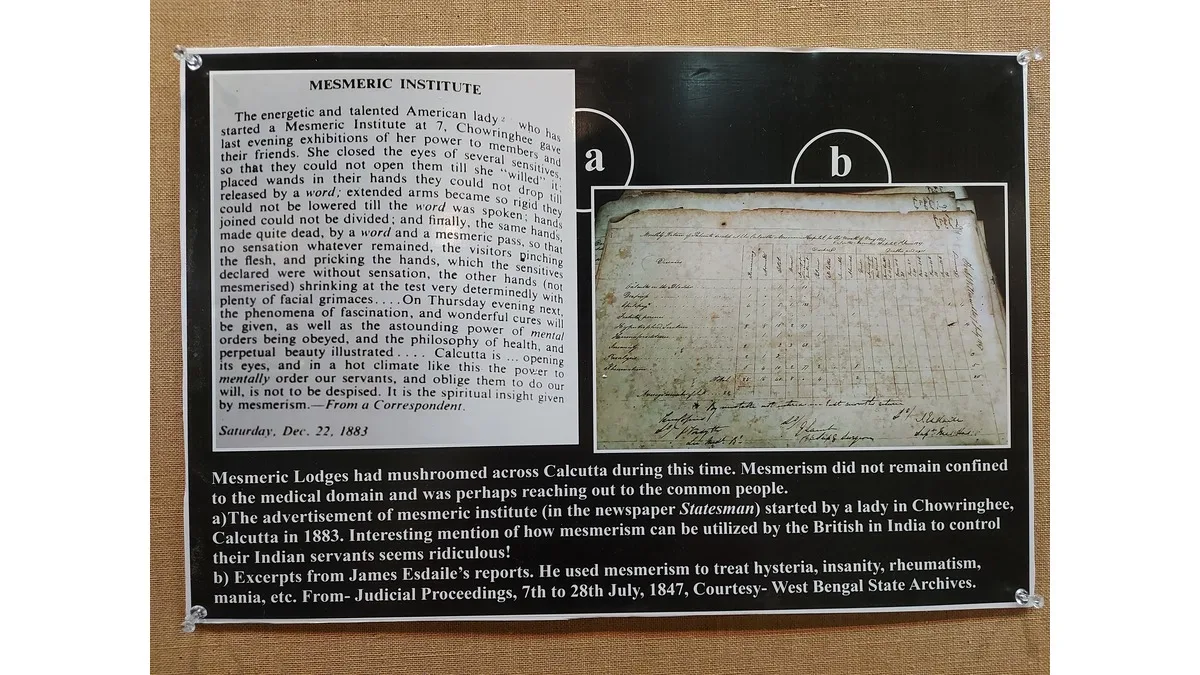
The photographs of certain interesting objects included the advertisement of a multilingual planchette board, manufactured by W. Newman and Co., Limited, Calcutta, that could facilitate automatic writing in Parsi, Nagri, English, etc. A panel focused on the examples of some occult objects (mostly of Indian origin) carried by soldiers during the First World War to highlight their transnational and cosmopolitan characteristics. Pictures of talismanic jewellery, including that of a tiger-claw necklace, were exhibited. Some Britishers in colonial India like, Fanny Parkes, were fascinated by tiger-claw ornaments, and several such pieces travelled to England. A particular slide focused on the advertisement of the ‘Hindu powder’, with the aid of which the Europeans were believed to have acquired the power of clairvoyance. There were a couple of slides that brought to focus information about Esdaile’s Calcutta Mesmeric Hospital, founded in 1848, and the treatments he offered through mesmerism. Unknown facets of history about the Calcutta based mesmerist Jogendranath Roychowdhury, a professor of Chemistry at St. Xavier’s College, was brought to notice during the exhibition. The objects used during mesmeric practices, like mesmeric sugar, water, and flannel pieces, were referred to. An advertisement published in The Statesman in 1883 about a mesmeric lodge run by an American lady at 7, Chowringhee Lane, Calcutta was showcased. How some British in colonial India, like John Woodroffe, Charles Stuart, etc., ‘went native’ and their particular interest in Indian occult objects was also brought to focus.
The exhibition was inaugurated on 25 August 2025 by Prof. Debarati Bandyopadhyay, the Head of the Department of English, Visva-Bharati, which was followed by a research scholars’ panel discussion on the importance of gothic studies. Research scholars, mostly from Visva-Bharati, from diverse academic backgrounds, participated in the interdisciplinary panel discussion. Interesting papers on the practice of occultism in colonial Bengal, Esdaile’s Mesmeric Hospital, Automata as Curiosities in Victorian England, etc. were presented by the participants. During the discussion session, questions like how we can look at the wish-fulfilling objects referred to in children’s literature, or whether we can think of Aladdin’s magic lamp as an occult object, were raised. Rituraj Das, a PhD research scholar at the Department of English, Visva-Bharati, reflected how, in India, because of the prevalence of the caste system, certain foods and associated practices are often encrusted with occult meanings.
A one day workshop was organised on 27 August 2025 as part of the exhibition. The outcome was a wall of stories where students had put up slips of paper in which they scribbled about the depiction of occult objects in various fictions. Some occult objects like talismans, amulets, horoscopes, etc., which are part of our indigenous culture, were put on display at the exhibition venue.
The research exhibition was the outcome of the Charles Wallace India Trust Visiting Fellowship undertaken at the Department of History, University of Leeds, U.K. in 2023. Archival resources were consulted at the British Library, Wellcome Collection, Brotherton Library, etc., for the purpose of the exhibition. Resources consulted at the Kala Bhavana Library in Santiniketan also added fresh perspectives to the exhibition.
The exhibition left behind questions as to whether ‘commodity racism’ was promoted through the occult objects, and the necessity to decolonise the museum spaces in this regard was thrust upon. The exhibition addressed how object studies as an interesting research methodology can bring to the forefront unknown facets of micro-histories pertinent to the India-UK relationship during the nineteenth century. How the occult objects enabled diverse forms of collaboration, exchanges, and encounters between the two nations was the major focus area of the exhibition.